

Ryan Skraba


Everything a Data Engineer needs to know
A File Format? A data format?
A data model?
A code generator?
A serializer for my existing code?
"Apache Avro™ is the leading serialization format for record data, and first choice for streaming data pipelines."
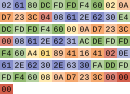
The Binary Serialization Story
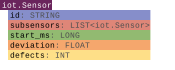
{
"type" : "record",
"name" : "Sensor",
"namespace" : "iot",
"fields" : [
{"name" : "id", "type" : "string"},
{"name" : "start_ms", "type" : "long"},
{"name" : "defects", "type" : "int"},
{"name" : "deviation", "type" : "float"},
{"name" : "subsensors",
"type" : {"type" : "array",
"items" : "Sensor"}}
]
}Gotcha: Determinism
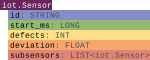
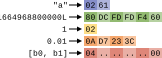
Q: Does serialize(42) always equal serialize(42)?
A: Usually, but…

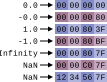
⚠️ Attention when using serialized bytes as keys in big data!
Gotcha: Precision
An 8-byte IEEE-754 floating point number has nearly 16 decimal digits of precision
An 8-byte LONG integer has nearly 19
Usually not a problem, except… JSON!
{
"type" : "record",
"name" : "Sensor",
"namespace" : "iot",
"fields" : [
{"name" : "id", "type" : "string"},
{"name" : "start_ms", "type" : "long"},
{"name" : "defects", "type" : "int"},
{"name" : "deviation",
"type" : ["null", "float"]},
{"name" : "subsensors",
"type" : {"type" : "array",
"items" : "Sensor"}}
]
}Gotcha: Meditation on the nature of nothing
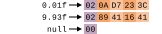
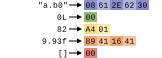
Q: How many zero byte datum (NULL) can you read from a zero byte buffer?
A: … a bit more than infinity.
# Eight primitives
"null"
"boolean"
"int", "long"
"float", "double"
"bytes"
"string"
# Two collections
{"type", "array", "item": "iot.Sensor"}
{"type", "map", "item": "iot.Sensor"}
# Three named
{"type", "fixed", "name": "F2",
"size": 2}
{"type", "enum", "name": "E2",
"symbols": ["Z", "Y", "X", "W"]}
{"type", "record", "name": "iot.Sensor" ...}
# Plus unionBYTES
FIXED
⚠️ Don’t use MAPs in partition keys
# Unqualified name
# Null or default namespace
{"type":"fixed","size":2,
"name":"FX"}
# Qualified with a namespace
{"type":"fixed","size":3,
"name":"size3.FX"}
{"type":"fixed","size":3
"namespace":"size3",
"name":"FX"}
{"type":"fixed","size":4,
"name":"size4.FX"}Namespaces are inherited inside a RECORD
{"type", "record",
"name": "Record",
"namespace": "size4", ⚠️(inherited)
"fields": [
{"name": "field0", "type": "size3.FX"}
{"name": "field1", "type": "FX"} 🔴
]
}⚠️ Best practice: use a namespace!
# Sometimes works
{"type":"fixed","size":12,
"name":"utf.Durée"}
# Better
{"type":"fixed","size":12,
"name":"utf.Dur",
"i18n.fr_FR": "Durée"}Avro names are never found in serialized data!
[_a-zA-Z][_a-zA-Z0-9]
⚠️ Best practice: Follow the spec here.
{
"type" : "record"
"name" : "Sensor",
"namespace" : "iot",
"fields" : [
{"name" : "id", "type" : "string"},
{"name" : "start_ms", "type" : "long"},
{"name" : "defects", "type" : "int"},
{"name" : "deviation", "type" : "float"},
{"name" : "temp",
"type" : ["null", "double"],
"aliases": ["tmep", "temperature"],
"default": null},
{"name" : "subsensors",
"type" : {"type" : "array",
"items" : "Sensor"}}
]
}Some attributes don’t take part in simple serialization.
Except when they do…
⚠️ Best practice: Check your SDK
Gotcha: (Java-only) CharSequence or String, ByteBuffer or byte[]?
By default, Avro reads STRING into Utf8 instances
{"type": "string", "avro.java.string": "String"}Avro reads BYTES into ByteBuffer instances.
Be kind, rewind()
Gotcha: Embedding a schema in a schema
Succinct
{"type":"array","items":"long"}Verbose
{"type":"array","items":{"type":"long"}}Nope
{"type":"array","items":{"type":{"type":"long"}}}Gotcha: {"type": {"type": … }}
{
"type" : "record",
"name" : "ns1.Simple",
"fields" : [ {
"name" : "id",
"type" : {"type" : "long"},
}, {
"name" : "name",
"type" : "string"
} ]
}Conceptually fieldType and fieldName
Important when adding arbitrary properties!
Primitives use the simple form.
Remove all unnecessary attributes and all user properties.
Use full names, remove all namespace
List attributes in a specific order.
Normalize JSON strings, replace any \uXXXX by UTF-8.
Remove quotes and zero padding in numbers.
Remove unnecessary whitespace.
{
"type" : "record"
"name" : "Sensor",
"namespace" : "iot",
"fields" : [
{"name" : "id", "type" : "string"},
{"name" : "start_ms", "type" : "long"},
{"name" : "defects", "type" : "int"},
{"name" : "deviation", "type" : "float"},
{"name" : "temp",
"type" : ["null", "double"],
"aliases": ["tmep", "temperature"],
"default": null},
{"name" : "subsensors",
"type" : {"type" : "array",
"items" : "Sensor"}}
]
}**{"name":"iot.Sensor","type":"record","fields":[
{"name":"id","type":"string"},{"name":"start_ms
","type":"long"},{"name":"defects","type":"int"
},{"name":"deviation","type":"float"},{"name":"
temp","type":["null","double"]},{"name":"subsen
sors","type":{"type":"array","items":"iot.Senso
r"}}]}**64bit Fingerprint: 5614D05749C8743
Deep dive into HOW, which answers a couple of WHY:
Why isn’t there a SHORT type? A UINT?
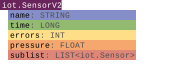
The basic Avro data model and how to write a schema
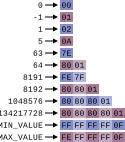
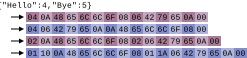
Tagless, streamlined binary encoding
Using Avro
API V1 (aka Actual) (aka Writer)
API V2 (aka Expected) (aka Reader)
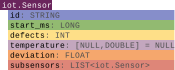
Every Sensor V2 temperature field will be read with NULL
Store and order the schemas for a subject, and enforces compatibility guarantees when introducing a new schema.
BACKWARDS: V4 ➜ V5 guaranteed; consumers update first
FORWARDS: V5 ➜ V4 guaranteed; producers update first
FULL: V4 ⬌ V5 guaranteed
Suffix _TRANSITIVE to apply to ALL older schemas
API V1 (aka Actual) (aka Writer)
API V3 Drop a field
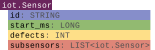
API V4 Reorder fields
⚠️This one trick drives schema registries crazy!
Avro binary data never has names in it.
Don’t use a schema pair 😱
Stick the new name in the same position in the "writer" schema.
Let us never speak of this again.
Primitives can be widened / promoted:
INT ➜ to LONG, FLOAT, or DOUBLE
LONG ➜ to FLOAT, or DOUBLE
FLOAT ➜ to DOUBLE
STRING ⬌ BYTES are interchangeable
⚠️ LONG to DOUBLE loses precision but you’re asking for it
if both array ➜ the item type matches
if both map ➜ the value type matches
if both fixed ➜ the size is the same
if named ➜ the unqualified name is the same
if both enum ➜ symbols are resolved by name
if unknown enum symobl, use default
otherwise an error at deserialization time
Making a field optional:
LONG ➜ to UNION<NULL,LONG>
Making a field required: ⚠️
UNION<NULL,LONG> ➜ to LONG
Adding a message payload:
UNION<A,B,C,D,E> ➜ to UNION<A,B,C,D,E,F>
Removing a message payload: ⚠️
UNION<A,B,C,D,E> ➜ to UNION<A,B,D,E>
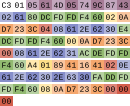
0xC301 + 8 byte fingerprint
Doesn’t specify how to store, fetch, resolve, decode…
⚠️ PCF drops evolution attributes!
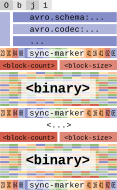
Obj1 + metadata
16 byte sync marker
Splittable
Compressable
Appendable
date: on INT (days since 1970)
time-millis: on INT (ms since midnight)
time-micros: on LONG (µs since midnight)
timestamp-millis: on LONG (ms since 0h00 1970 UTC)
timestamp-micros: on LONG (µs since 0h00 1970 UTC)
duration: on FIXED(12) for three little-endian UINT32: months, days, ms
decimal: on FIXED and BYTES, scale, precision
uuid: on STRING
Generic / Specific / Reflect
Code generation
Avro IDL
Avro in the Big Data Ecosystem
Byte Representation Consistency
Multi-language Interoperability
Distributed-Data Friendly: Splittable, Compressable, Appendable
Data (Record) Exchange Format (Serialization)
File Format
IDL / RPC
Most popular serialization format for Streaming Systems
Why Avro excels for this use case?
Efficient format and Schema Evolution
Language-based serialization (e.g. Java, Pickle):
Not consistent, Language specific
JSON: Schemaless
CSV: Verbose, Inconsistent
XML: Too verbose
Protocol Buffers: IDL/RPC oriented (gRPC)
Apache Thrift: Protocol definition format
Flatbuffers: No need to decode in memory

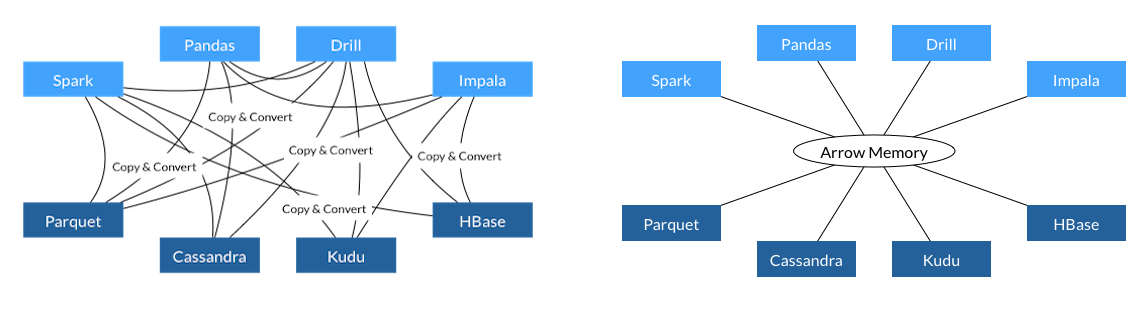
Apache Arrow: Memory layout format designed for language-agnostic interoperability.
Arrow2 (not Apache) can represent Avro records as Arrow records.
Supported by all Big Data Frameworks and (Cloud) Data-Warehouse

JSON, XML: Non-splittable
CSV: Not a standard
Protobuf: Low ecosystem support for the file use case.
Parquet: Column-based, efficient for Analytics.

Columnar formats are better suited for analytics:
column pruning, vectorization, stats).
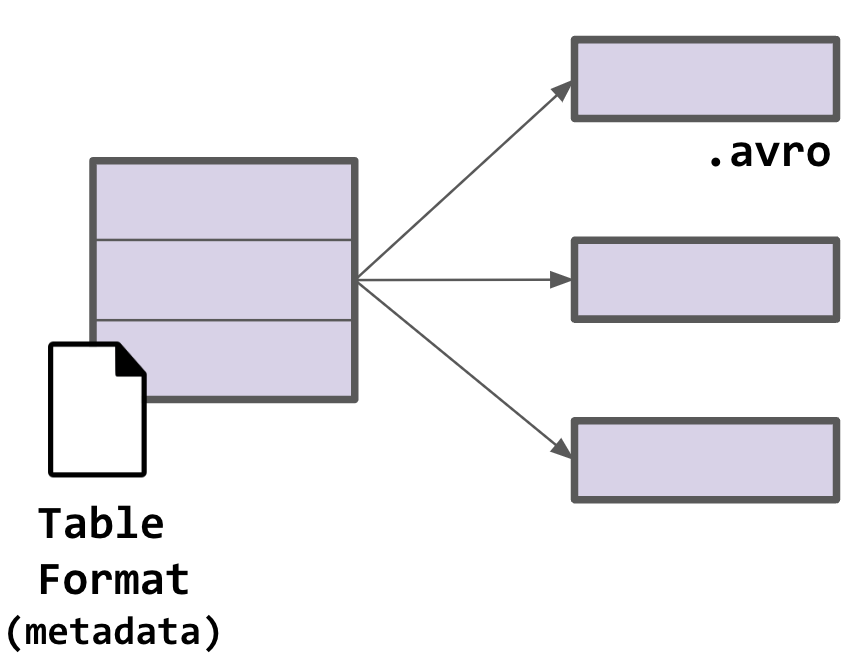
Table formats are metadata to represent all the files that compose a dataset as a “table”.
Avro can be one of those formats (i.e. Iceberg).
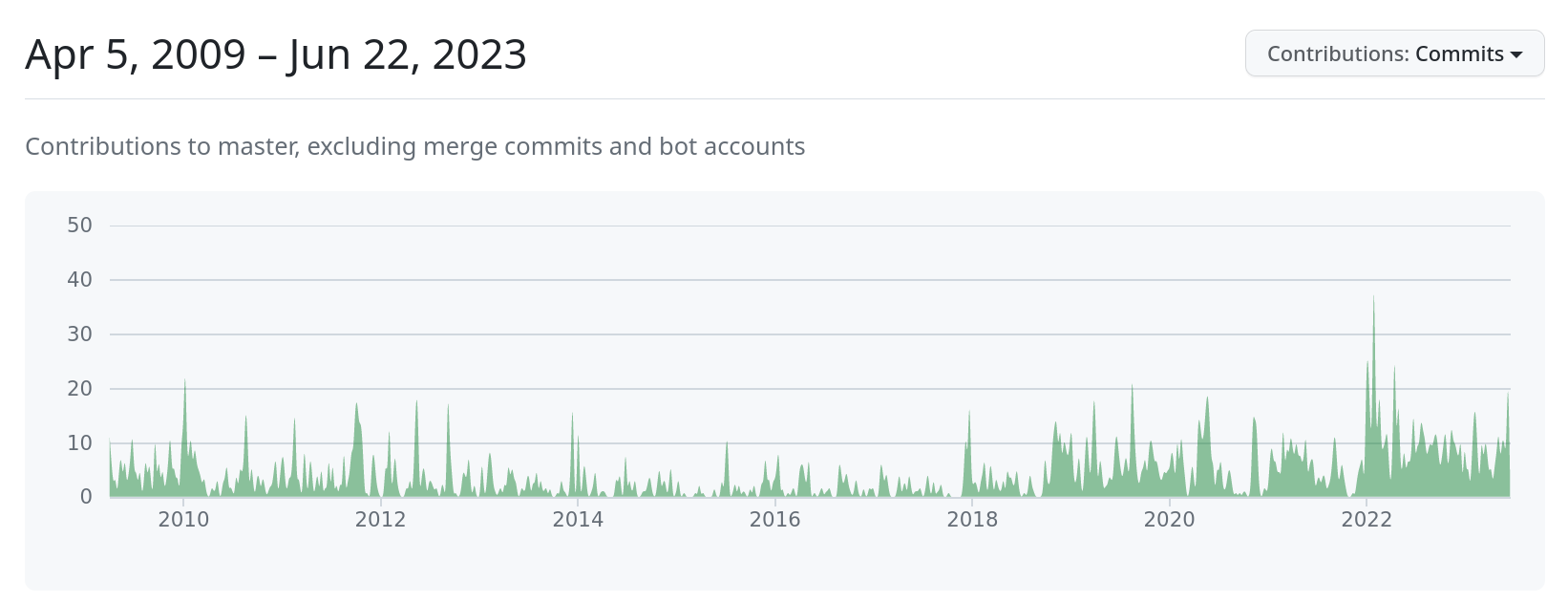
Ecosystem Support
Active community
Stable Specification, not broken since 1.3 (12 years!).
Logical Types in 1.8 are backwards/forwards compatible.
Language Support
Apache: C, C++, C#, Java, Javascript, Perl, PHP, Python, Ruby, Rust
Non-Apache: Python (FastAvro), Go, Haskell, Erlang, etc.

Improved Release Cadence
Improved Contributor Experience:
Github Actions, Docker, Codespaces
New Website
Rust Implementation (donated by Yelp)

Format
Is it worth to break the spec at this point?
Is there room for improvement given the stability constraints?
Implementations
Semantic Versioning. How to do it with so many languages?
Automation specially for the release.
Performance and Interoperability Tests
Improved documentation
No format is perfect for everything, there are different use cases where different formats excel.
Use Avro where it fits.
Join us?
https://avro.apache.org